©

Date
Sep 2025
Client
HireGains
Industry
HR Tech / AI
Timeline
7 Months
Hero

Brand redesign

The Challenge
Screening capacity was already the constraint. Generative writing tools removed the last discriminating signal from the artifact the screen was built on.
High-volume hiring resolves hundreds of applicants through a fifteen-minute screen, and it does that on the strength of a document that no longer separates one candidate from another. Applications now arrive normalised by the same generative tools - comparable phrasing, comparable claims, comparable references, which leaves certification and availability as the only fields still carrying information. What the screen was meant to establish stays out of reach: how a person holds a room under pressure, and whether the conditions they're walking into are the ones that already made them leave the last job. Turnover on these roles runs between 30 and 50 percent a year, a fifth to a third of accepted offers never reach day one, and the unstructured interview carrying the decision predicts performance at under fifteen percent accuracy. The failure sits in the instrument rather than in the recruiter.
Job Interview

The Solution
An evaluation architecture that resolves unstructured human signal into auditable, defensible candidate–environment fit.
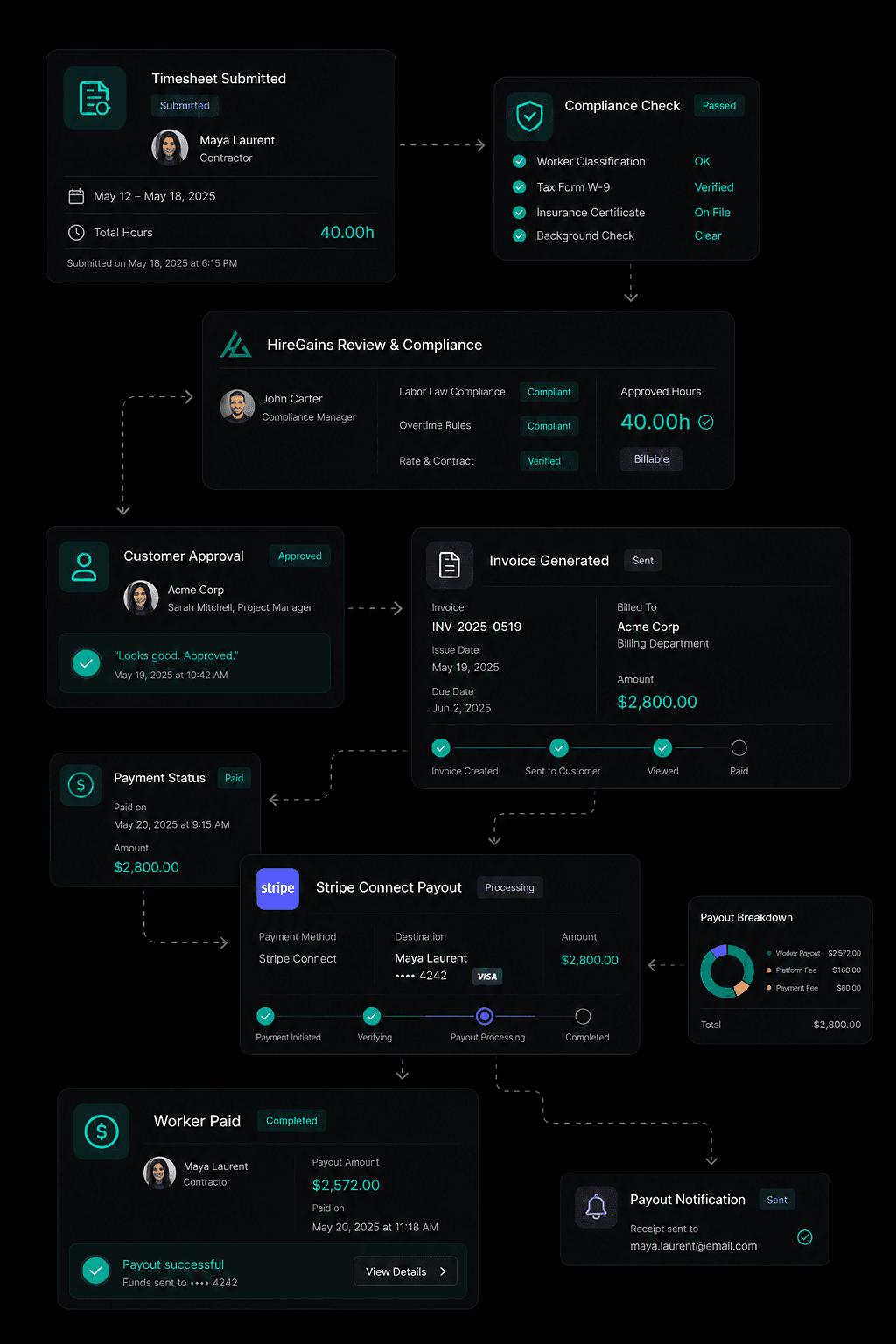
Under the surface, an interview engine drives an adaptive scenario sequence, modulating depth in response to what the candidate reveals rather than executing a fixed script. Linguistic, reasoning and behavioural markers are extracted into a multi-signal profile: capability, workstyle, pressure response, and the retention variables that conventionally surface only post-hire. The platform was built as infrastructure. Interview engine, scoring schema, profile model and matching layer are independently versioned, so signal quality holds whether the system runs a single conversation or forty thousand, in a clinical unit or on a night dock.
Diagram
The Process
We embedded into the founding team and owned the technical direction - from architecture through to a platform running in production.
The founders brought two decades of operating depth in recruiting at scale. We brought the system. Working as part of their team, we took a problem they understood in practice and resolved it into architecture: what the interview engine had to guarantee, where the scoring schema drew its boundaries, which parts of the model needed to survive a change of role, a change of cohort, a change of vertical. Seven months in, HireGains repositioned into high-volume frontline hiring. Swapping the vertical meant swapping the scenario library and recalibrating the schema against a new set of outcomes. The engine, the profile model and the matching layer carried over intact.
Psychology metrics

By the numbers

Latest projects